The good, the bad and the horny
After twenty-nine weeks living “in community” I’m convinced that you’re mistaken if you think it’s not something that will enhance your life, whoever you are.
I’ve lived with at least 500 people over the last two years: between two and two-hundred at any one time; usually fifteen to sixtyish. Great friends new and old, lovers, romantic entanglements, a couple of temporarily trainwreck-vibed romances, little 1920s steam boats in foggy waters, never to be seen again, juicy fruits that melted my loins, shooting stars that inspired me to embody more kindness, bravery and creativity.
These people spanned spectrums: from quiet, learned, high-achieving, bookwormy introverts to heavily social, funny and raucous stage performers who shoot fireworks out of their ass cracks; from neurodivergent humans with deep intellects and otherworldly creative verbal gymnastics skills who previously went years speaking a word to nobody to German, blonde-Aryan, jacked, 20-something, kite-surfing, finance bros, executing loud morning business calls pacing the balcony, wireless headsets strapped to faces; from world-record holding acrobats constantly contorting with a combination of mobility, strength and endurance I never knew possible to long haired, psychoanalytic musicians who duet with themself combining virtuoso whistling with majestic violin soloing; from multimillion-dollar business owning entrepreneurs to broke uber-talented artists who weave clothes from the forsaken flora of the forest; from psychonauts who sometimes do fifteen tabs of acid in one go and have “a nice time” in the experience to people who have never even tried coffee. Contrasts. Diversity of outlook and way of being. And within that range, the properties that bloom when group-living is held with both enough structure and sufficient flexibility.
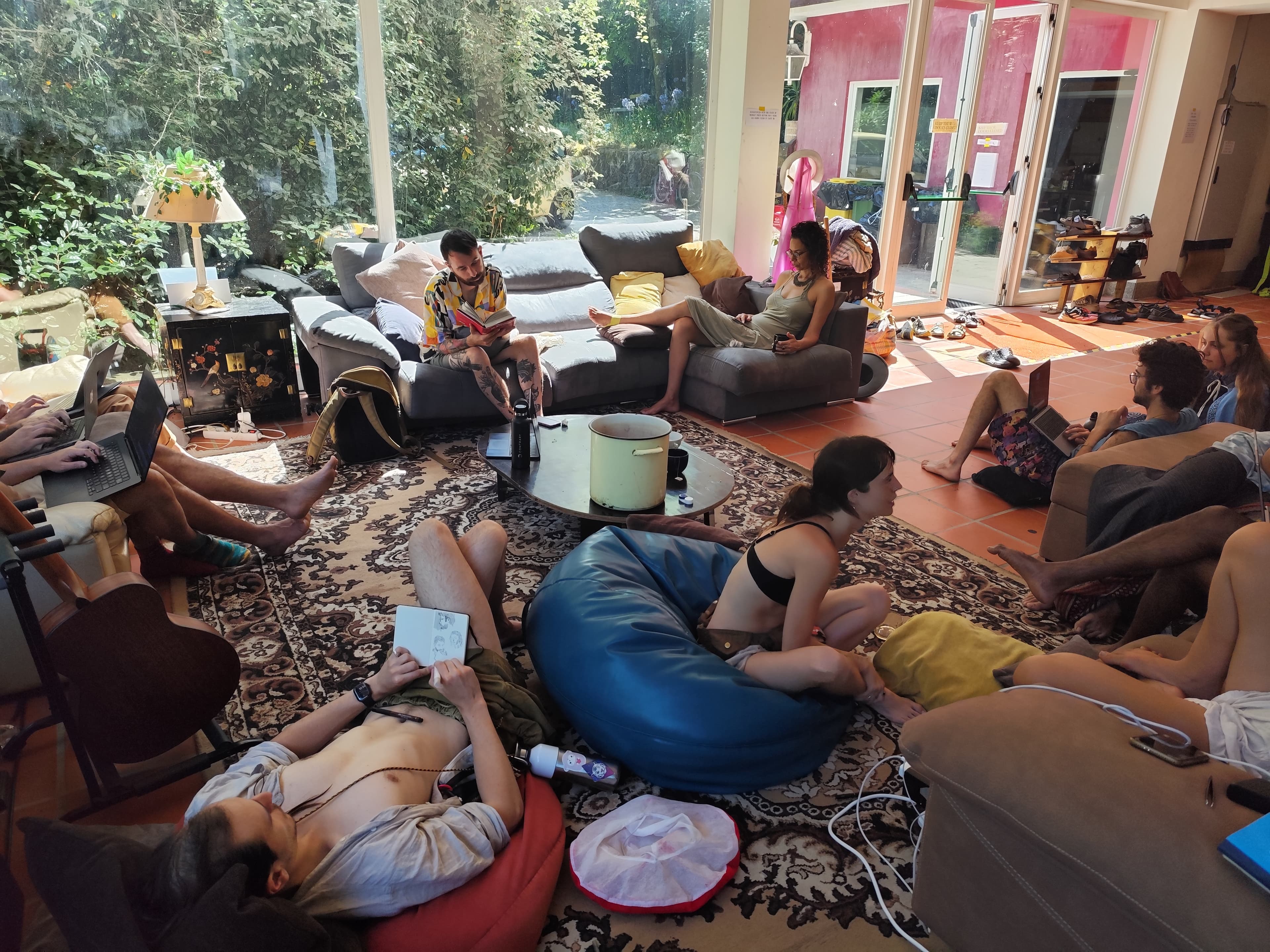
 Afternoon hang at The Garden
Emergent properties of community
When support and freedom are there in the right balance in community, people are free to be themselves whilst being free to support each other. What emerges from the primordial goo of that social ecosystem is — within a sufficiently well-guided community — attunement. Often gradually and then suddenly, the group attunes, wrinkles in the cloth gradually iron out; individuals attune, too. Some people are just very good at being a presence that others love to be around. Others, many, have had less experience, fewer good examples and less time in their lives to practice. They are more inconsistent. Community is the feedback mechanism by which these people — myself included — get to return again and again to regulation in a field of others, such that we can own and live our boundaries and desires while simultaneously harmonising with those around us. We drive the road through that field of harmony to the place where we are true; to the place we connect profoundly with others.
A genuine seeing, knowing and loving emerge when we have the space to take a pause before returning to those who trigger us. Such is our reality in the “normal world” that we might never see these people again when we’re triggered outside of community. Always surprising, these disconnection-to-reconnection arcs are often where the best relationships begin.
 Coworking is less lonely than alone-working
I’ve spent about 29 weeks in community in the last two years
- Two months at the Life Itself hub in Bergerac: a seventeen-ish bedroom, 1740s house in the southwest of France with a bunch of people who work in realms with questions such as how do we live a wiser, healthier, more harmonious, flourishing life on a species-wide scale?
- Eighteen weeks in The Garden: A 20-acre forest in the north of Portugal from whence most of the characters in my intro were sourced and from where the majority of the huge transformation in my experience of life in the last few years has been cooked up.
- A couple of weeks across two communities near Lisbon: Fool’s Valley and the Transformational Connection hub. One, a windswept beautiful house, with a dance studio and kitchen-dinner buried in gusty, atmospheric aridity. The other, a 7-bedroom villa and swimming pool where people go deep on the relational meditation practice known as Circling or Transformational Connection for a few hours every day.
- As I write this I sit in the garden of Casa Tilo. Rich and Nati’s 10-bedroom villa, thirty minutes from Barcelona. A place where retreats are attended by facilitators, zealots for positive personal transformation, thinkers, meditators and others. It’s Ship It Week here at the moment: a 10-day container where while accessing the nourishing joy of life together, twenty-two people have come together to get shit done. Hashtag Ship It!
I’ve been compiling a list of 100s of communities, sorted by type and location. Most of the info was collected and compiled by a miscellany of others. Shout out to them. I brought it together in one place and host it here. In addition to my social media, this post and others are my attempts to add some color to these lists where my experience allows.
Immersion with people
 Lunch with trees and guitars > lunch without trees and guitars
On top of what I’ve mentioned above, I’ve spent time living with 15–100 people most hours, most days, for months at a time, about ten times in my life. A few years ago I used Tim Urban’s “A life in months” chart. One A4 page covered in small squares, each little box representing one month of a ninety-year life. I annotated my past. Something unquestionable jumped out. I am significantly happier when I live with a group of others. From living with 100s of disaster relief volunteers to immersing my life in a Dragon Boat team for a year, and a bunch of other adventures. I’m hoping to write about these another time.
Nodal vs nuclear communities
 Bendy trees
The thousands of communities I haven’t yet visited fit into a model of community that my friend Alex and I came up with. It’s pretty simple and probably nothing new.
On one axis the model claims that communities are either nuclear or nodal. On the other, temporal axis, they’re either short retreats, longer residencies, or longer form communities. Obviously communities can be modelled in many ways. This is one model that was useful when we were considering how to get started while trading off the pros and cons of each.
At the moment I’m particularly interested in the nodal model on long-term and shorter-term timelines. Fractal NYC is the best example I know of something similar, with about 20 new Fractals being seeded in the last couple of months in cities around the world including Mexico City, London, Porto, and Tokyo. Alex and I are thinking of starting a new one soon … tbd!
Fractal is a few things, as far as I can tell from afar. Simply put, it’s people coordinating to live very close to each other in a big city: hundreds of people living in multi-person apartments fewer than 10 minutes walk from each other. Group-living apartments are also used for workshops and events of any flavor, and act as third spaces where people can swing by and hang out sharing food, activities and human connection. Basically, in this era of increasing urban isolation, they’re bringing back the neighborhood. I think I may want to join or make one of these soon!
When I talk about my experiences in community there are some common questions. Here’s a quick FAQs. These answers are specific to my experience in the communities I’ve been in. These might not be what most communities look like. Also, there’s a selection bias in my experiences because I seek out communities with the qualities I find.
FAQs
How much do these places cost to stay?
Massively varied, but the ones I stay at usually work out around $50 per day all in. Depending on accommodation choice in community this can be significantly higher or lower. There are sometimes options to volunteer and live for free or much more cheaply. People are employed in communities but often these roles take getting to know the community more on the ground first. Living at the community you also work at is a significant immersion. There’s often wisdom in both parties involved knowing each other before people start working where they live.
Is it a commune? A cult? A sex cult?!
Commune isn’t a word I use. It seems to me that it implies different things to different people. A sex cult? Well, having sex in the woods against a tree is as fun as I remembered, but alas, no sex cult vibes. My experiences have been people living together with a spirit of connection and cocreation seeing what sprouts from there. All of my experiences have at least a little shared responsibility: cleaning occasionally etc; some require a greater investment of time, working hours a day on things related to the community.
What’s the structure of people’s day like / what do people do there?
In my experience, people use their days in a wide variety of ways. My days usually combine eating with others, doing some work, swimming, dancing, singing and playing guitar, playing in nature, cuddles and deep talks, sun on the body, sometimes on my butt, napping, group workshops run by each other, emergent cocreation, often of the musical or dancey type, and a whole bunch of other things.
How do I join?
My sense is the most important thing is cultural fit. Are you into the things this place says they’re into? Might you be? If not, check out other places. Some are more wild and free, some more calm and closer to mainstream society. Some are more facilitated, some more left to go it alone. Some close to civilization, some not. What do you want? Where can you find it?
What are they like?
Wonderful and magical, hard and lonely, up and down. You are still living life and, as you know all too well, being human is sometimes hard. Most of our ancestors spent their days living with dozens of people. We’ve stopped doing that and we’re paying the price in loneliness, isolation, anxiety, depression and malfunctioning societies. Living with others is the best solution there is on the individual, group and species wide level. Strong claim: I stand by it.
What are you going to do about it?
When I’m feeling capable and brave my answer is that I’m going to start a distributed urban community. First I need to lock my life back into rooted stability after nearly a decade living nowhere for more than a few months at a time. I plan to do that before this year ends.
See you in the group. I’ll dance with you by the fire.
Note: We were planning on making our own community a couple of years ago and landed $50k of funding. Not huge but enough to feel disappointed when we eventually decided to turn it down for a few reasons.